


Lisbon is a city of contrasts—where centuries-old traditions meet modern energy, grand palaces share space with vibrant street art, and every hilltop rewards you with a breathtaking view. While landmarks like Belém Tower and the Jerónimos Monastery are must-sees, the true magic of Lisbon lies in the hidden corners, quiet gardens, and unexpected finds. This guide takes you beyond the typical tourist trail to discover a more intimate and authentic side of Portugal’s capital.
Scenic Vistas: The Best Views of Lisbon

A photo of the view of Lisbon skyline from the Miradouro da Graca. Image by M.Northey
Miradouro da Graça: A Tranquil Viewpoint with History
Lisbon’s hills offer no shortage of stunning viewpoints, but few are as peaceful and picturesque as Miradouro da Graça. Located near the Castelo de São Jorge, this spot gives you a panoramic glimpse into Lisbon’s past and present, where terracotta rooftops tumble down towards the Tagus River.
The best way to reach Miradouro da Graça? Hop on the legendary No. 28 tram, which winds through the city’s oldest neighborhoods. Once at the top, relax under the shade of towering pine trees, sip a coffee at the café, and watch the city’s rhythm unfold below. It’s a perfect mix of history, nature, and a little bit of Lisbon’s soul.
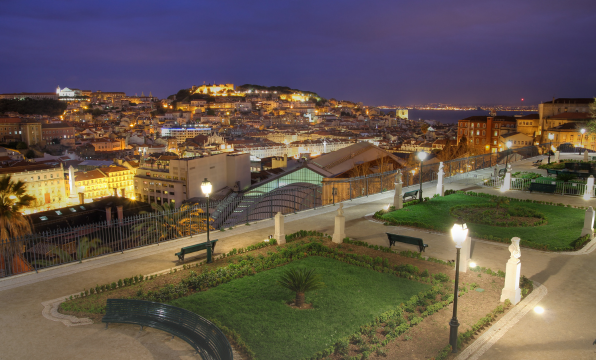
View at twilight from the Miradouro de San Pedro de Alcantara. Image credit: repistu, Getty Images, licensed through Canva
Miradouro de São Pedro de Alcântara: A Garden with a View
Another unmissable viewpoint is Miradouro de São Pedro de Alcântara, a beautifully landscaped terrace that offers an entirely different perspective of the city. Overlooking Avenida da Liberdade, the Baixa district, and the imposing Castelo de São Jorge, this spot is visually stunning and historically rich.
What makes this miradouro special is the garden itself—a peaceful escape where locals and visitors alike gather. There’s even a traditional azulejo (tile) map that helps you identify the landmarks dotting the skyline. For an extra touch of charm, grab a drink from the nearby kiosk and soak in the scenery.
Exploring Lisbon’s Royal Heritage
Ajuda National Palace: A Step into Portugal’s Royal Past

Interior of the Ajuda National Palace, Lisbon. Image source: Visit Lisboa (visitlisboa.com)
If you want to see how Portugal’s royals once lived, the Ajuda National Palace is the place to visit. This grand neoclassical palace became the official residence of King Luís I in the 19th century and remains a stunning testament to the opulence of that era.
Unlike many European palaces, Ajuda maintains its original furnishings, decorative arts, and lavish rooms. On the ground floor, you’ll find the private apartments, while the upper level showcases the grand State Rooms, where major events still occur. From intricate gold and silver works to historic paintings and sculptures, every corner of this palace tells a story.
Jardim Botânico da Ajuda: A Historic Oasis of Greenery
Tucked behind the palace, Jardim Botânico da Ajuda is Lisbon’s oldest botanical garden. Established in 1768, this lush green space was originally used to educate Portuguese princes about botany. Today, it remains a beautifully preserved retreat where you can admire thousands of plant species worldwide.
The garden is divided into two levels: the upper level features King José’s ponds and a collection of tropical trees. In contrast, the lower level boasts a baroque-style garden with fountains and medicinal herb beds. The views over the Tagus River make this an especially serene spot to pause and appreciate nature’s quiet beauty.
Lisbon from the Water: A Unique Perspective
Cais do Sodré – Cacilhas Ferry: The Iconic Orange Boat Ride

Belém Tower on the Tagus River, Lisbon. Photo by Andrey / Getty Images licensed through Canva
Step aboard the Cais do Sodré – Cacilhas ferry for a different angle of Lisbon. This bright orange boat is more than just a means of transport—it’s an experience.
As the ferry glides across the Tagus River, you’ll be treated to a sweeping view of Lisbon’s skyline, with its mix of historic towers, modern bridges, and colorful waterfront buildings. If you take the ferry in the morning, you’ll arrive just in time to enjoy a seafood lunch at Cacilhas’ famed grilled fish restaurants.
A Treasure Hunter’s Paradise
Feira da Ladra: Lisbon’s Most Iconic Flea Market
If you love hunting for unique souvenirs, vintage finds, or quirky antiques, Feira da Ladra is a must-visit. This bustling flea market occurs every Tuesday and Saturday in Campo de Santa Clara, just behind the Monastery of São Vicente de Fora.
Dating back to 1272, this is Lisbon’s most historic market, offering everything from handmade crafts to rare second-hand treasures. Whether you’re searching for an old postcard, a retro vinyl, or a beautifully aged azulejo tile, you never know what you’ll stumble upon. After exploring the market, take a short walk to the nearby National Pantheon or the Igreja de São Vicente de Fora to complete your day.

Enjoying the charm of Lisbon on a tram
The Charm of Lisbon’s Historic Trams
No. 24 Tram: A Ride Through Time and Neighborhoods
Lisbon’s trams are more than just transportation—they’re a journey through time. The No. 24 tram is one of the city’s lesser-known routes, offering a fantastic ride through central Lisbon’s historic bairros.
Starting in Praça Luís de Camões, the tram winds through Príncipe Real and Rato before climbing up to Campolide. Along the way, you’ll pass by architectural landmarks like Glória Lift and the Torres das Amoreiras, an iconic yet controversial postmodern complex built in the 1980s. It’s a perfect way to experience Lisbon’s old-meets-new charm.
A Spiritual Escape Near Lisbon
Convent of Arrábida: A Hidden Sanctuary in Nature

Convent within Arrábida Natural Park, Portugal. Image courtesy of Visit Lisboa
For a truly off-the-beaten-path experience, take a day trip to the Convent of Arrábida, hidden within the breathtaking Arrábida Nature Park.
Unlike any other convent in Portugal, this 16th-century Franciscan monastery is built into the hills, with hermit-like cells scattered among the rocks. Some tiny dwellings are carved directly into the mountainside, creating a fairytale-like setting. Today, the convent is managed by the Fundação do Oriente, and visits must be booked in advance. This is the perfect spot if you’re looking for a peaceful retreat surrounded by nature and history.
Fado Music Lisbon: Soul of Lisbon: An Evening with Fado
As night falls in Lisbon, the city’s emotional heartbeat comes alive through Fado. Often performed in intimate taverns tucked along the winding streets of Alfama and Bairro Alto, this traditional music is raw, haunting, and deeply personal. A single voice, accompanied by Portuguese guitar, tells stories of longing, love, and saudade—a word uniquely Portuguese, capturing a sense of yearning that defies translation. Listening to Fado is not about spectacle; it’s about stillness, candlelight, and the quiet connection between singer and listener. To experience it is to feel Lisbon, not just visit it.
As night falls in Lisbon, the city’s emotional heartbeat comes alive through Fado, the music so closely tied to the Portuguese feeling of saudade—a deep, bittersweet longing that is difficult to translate yet instantly felt. Often performed in intimate taverns tucked along the winding streets of Alfama and Bairro Alto, Fado carries haunting melodies and poetic lyrics that seem to rise straight from the cobblestones themselves. A single voice, accompanied by the bright, tearlike tones of the Portuguese guitar, tells stories of love, loss, fate, and the passage of time, inviting listeners into a shared space of emotion rather than a polished spectacle.
When I experienced Fado in a small venue in Lisbon this past April, the setting was simple: low light, candles on the tables, and that quiet, expectant hush before the first notes were played. The focus was entirely on the singer and the guitar players, and in that stillness, the music felt less like a performance and more like being welcomed into a living room where the history and heart of the city are shared one song at a time. To be there was to feel Lisbon rather than just see it—to sense how this music has grown out of everyday lives and continues to carry the weight of memory and hope.
What moved me most, though, was the presence of so many young Lisboetas in the room with us. They hadn’t come as casual tourists; they were there to support their friends, to listen, and to participate in this tradition that has been part of the city for generations. After the main show, the evening shifted into an open-mic style Fado session, and you could feel the anticipation as they waited for their friends’ turn to sing. Their enthusiasm for this long-standing art form was contagious—clapping, encouraging, and celebrating each new voice that stepped forward. We left deeply impressed and genuinely hopeful, seeing how joyfully the younger generation is continuing this tradition and carrying Fado into the future with pride.
At Inspired Travel Designs, the best travel experiences go beyond the guidebooks. Whether you’re drawn to Lisbon’s breathtaking viewpoints, historic palaces, or hidden local gems, we craft personalized itineraries that let you discover the city’s true soul.
Let us design your perfect Lisbon adventure, taking you off the beaten path and into the heart of Portugal’s culture, history, and charm.
Produced by Inspired Travel Designs with Visit Lisboa and Virtuoso Travel